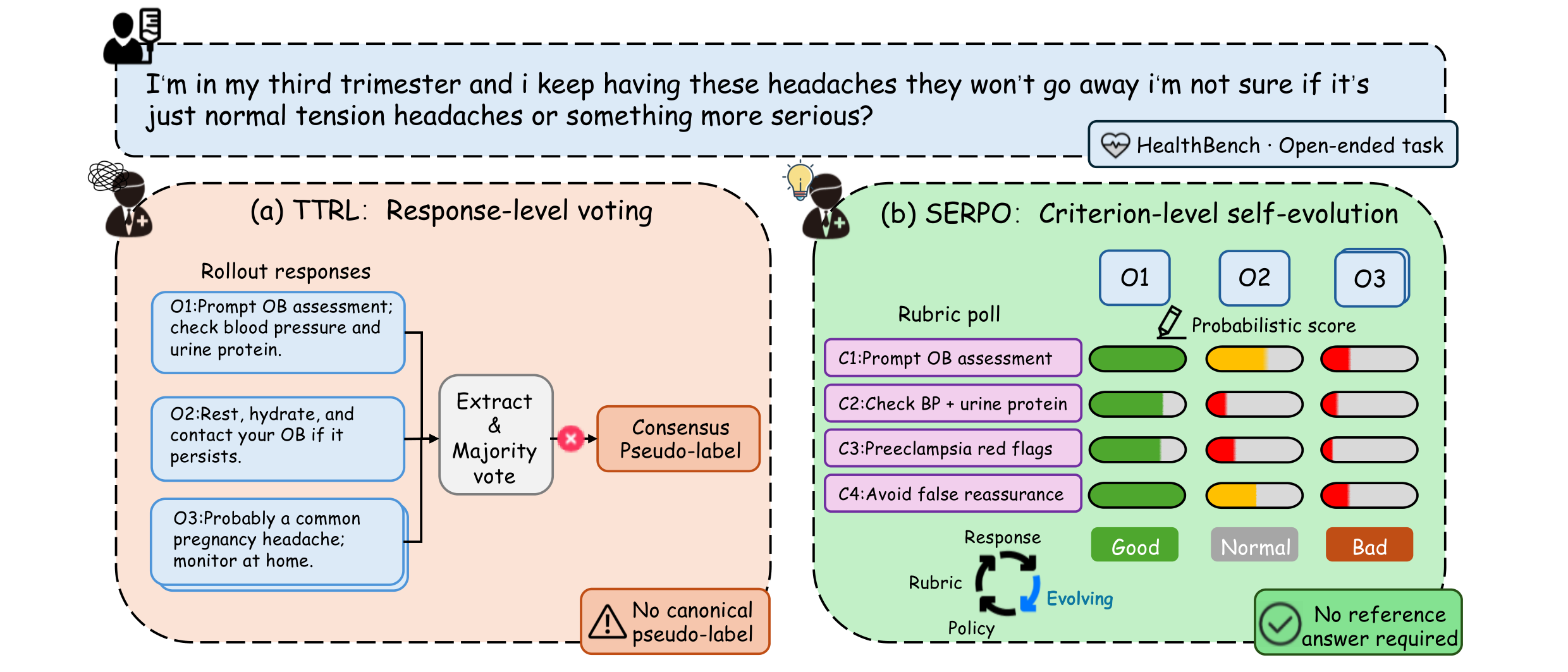
Response-level consensus
Frequent responses can share the same omission. A majority cluster can reward agreement without verifying the qualities that make an answer useful.
SERPO · arXiv:2607.26873
SERPO lets a model evolve at test time when there are no reference answers, no labeled feedback, no stronger judges, and no canonical target for majority vote.
In multiple-choice or symbolic tasks, voting can select a pseudo-label. In open-ended generation, responses can share a recommendation while differing in safety, completeness, uncertainty, and factual grounding.
Frequent responses can share the same omission. A majority cluster can reward agreement without verifying the qualities that make an answer useful.
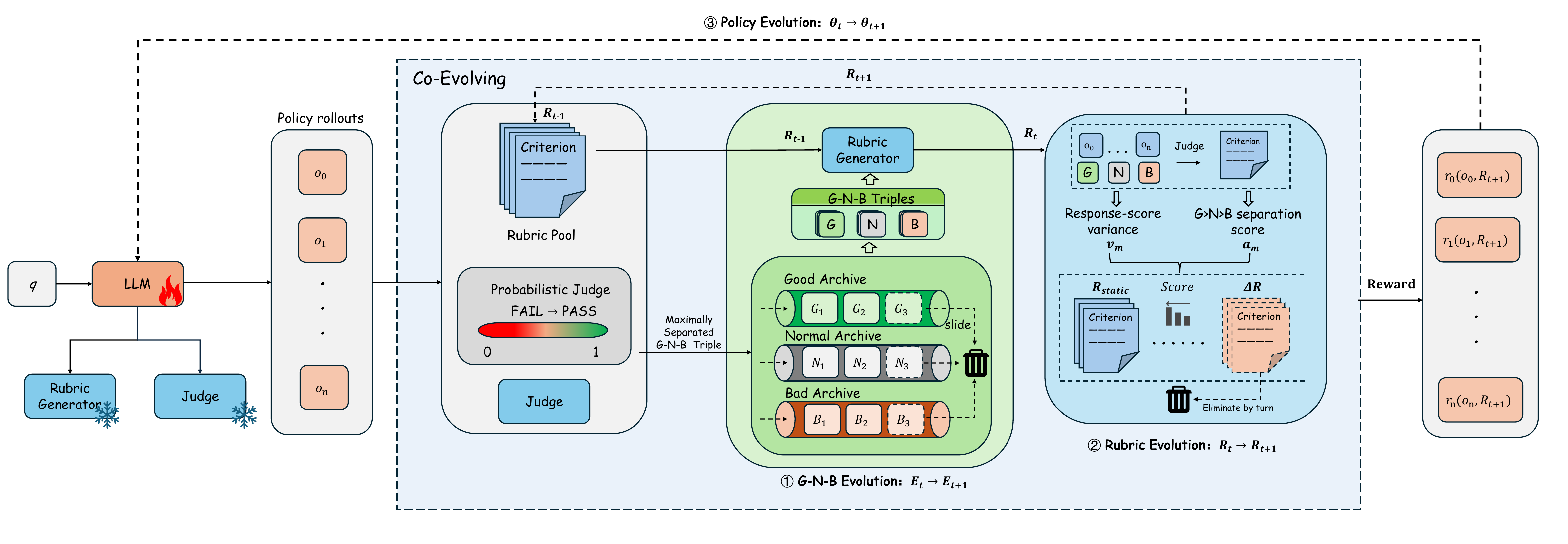
Query-specific criteria separate Good, Normal, and Bad response archives, then produce graded rewards through a frozen probabilistic judge.
SERPO stores prompt-local response evidence, refreshes the criteria that distinguish that evidence, and updates one shared actor with the resulting reward signal.
Rollouts are organized into Good, Normal, and Bad archives for each prompt.
Criteria are retained when they separate archive quality and pruned when they do not.
GRPO uses the rubric-derived scalar rewards to update the actor at test time.
The same result table is kept here so the narrative view remains a complete paper page.
Up to 20.63 points over the corresponding base model.
Up to 20.31 points over the corresponding base model.
Up to 8.06 points across six benchmarks.
| Model | Method | HealthBench | MedQA | LLMEval-Med | ResearchQA | GPQA-Diamond | RaR-Science | Avg. |
|---|---|---|---|---|---|---|---|---|
| Qwen3-4B | Base | 32.30 | 53.81 | 59.82 | 57.29 | 53.03 | 67.29 | 53.92 |
| Qwen3-4B | SERPO | 49.83 | 54.73 | 62.50 | 77.60 | 59.09 | 68.12 | 61.98 |
| Qwen3.5-9B | Base | 44.68 | 69.84 | 69.27 | 68.62 | 70.20 | 77.87 | 66.75 |
| Qwen3.5-9B | SERPO | 65.31 | 71.32 | 74.18 | 83.18 | 72.22 | 79.93 | 74.36 |
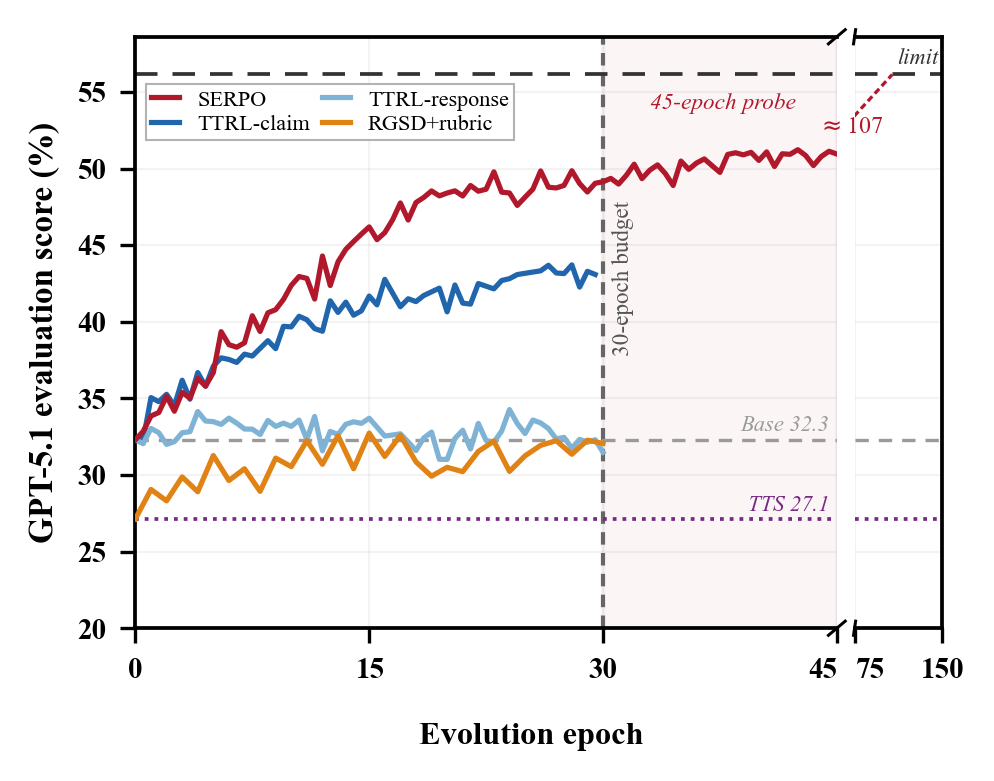
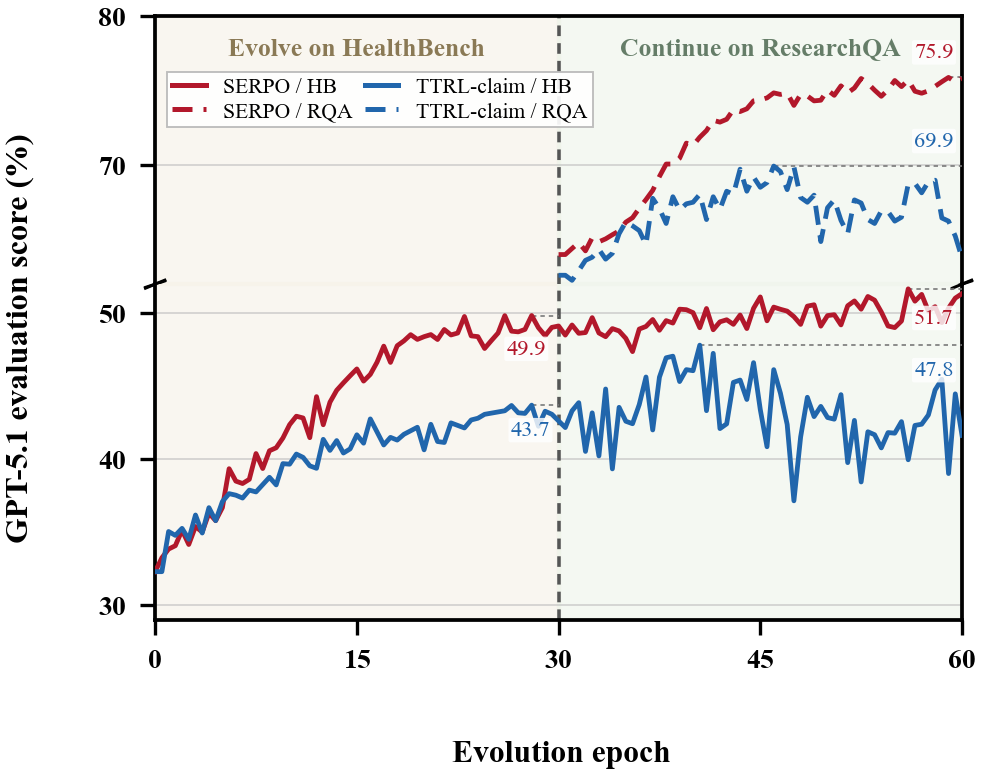
The detailed pipeline and evolution curves show how the method keeps reward resolution as the actor changes.
SERPO is the official implementation of the arXiv paper. The repository is released under Apache License 2.0.
@article{wang2026serpo,
  title   = {{SERPO}: Self-Evolving Rubric Policy Optimization for Open-Ended Test-Time Reinforcement Learning},
  author  = {Wang, Jianze and Zheng, Kunwang and Liu, Ying and Cao, Yu and Zhang, Qilong and Chen, Jinlong and Yang, Hua and Chen, Qianglong},
  journal = {arXiv preprint arXiv:2607.26873},
  year    = {2026},
  url     = {https://arxiv.org/abs/2607.26873}
}